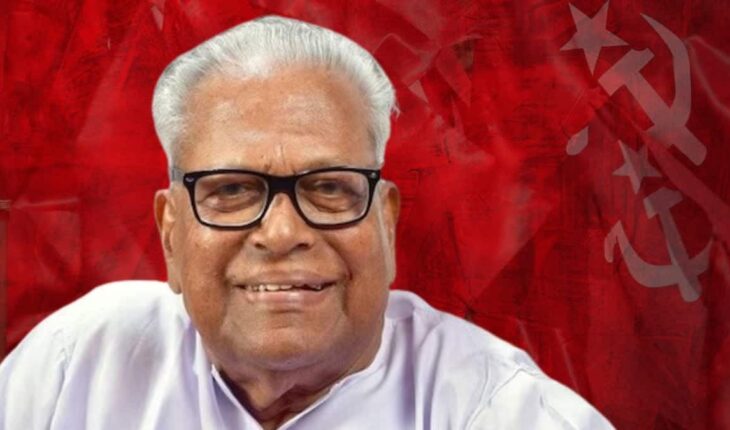
V.S. Achuthanandan, who died in Thiruvananthapuram on 21 July 2025 aged 101, was the last living link to the generation that carried communism from Kerala’s paddy fields to its Cabinet table.
Over eight decades the orphaned coir-spinner from Punnapra became the state’s best-known “people’s comrade”: a founding member of the Communist Party of India (Marxist), three-term Leader of the Opposition and, from 2006 to 2011, Kerala’s 11th Chief Minister.
Born on 20 October 1923 in Alappuzha district (then Travancore), Achuthanandan lost both parents before he turned 11, left school after Class VII and took to cutting coir for wages.
The hardship forged a stubborn resolve that caught the eye of P. Krishna Pillai, Kerala’s legendary communist organiser, who recruited the teenager into trade-union activities.
By 17 he had joined the undivided Communist Party. His baptism by fire came in 1946, when the Punnapra-Vayalar uprising against the Travancore princely state was crushed.
Arrested and tortured, he emerged with permanent injuries — and a reputation for fearlessness that never left him.
When ideological rifts split the Indian Left in 1964, Achuthanandan was among the 32 leaders who walked out of the CPI National Council to form the CPI(M).
Over the next four decades he rose from Alappuzha district secretary to Kerala state secretary (1980-92) and, from 1985, a member of the party’s Polit-Bureau.
His speeches — plain, sardonic and rich in shop-floor detail — helped translate Marxist theory into kitchen-table politics. Workers, fisherfolk and farmers hailed him simply as “VS”.
For 14 years in the Assembly he led the Opposition with a street-fighter’s flair, skewering land-sharks, lottery mafias and nepotists. Yet it was only in 2006, at 82, that Achuthanandan finally donned the chief-ministerial robe, becoming India’s oldest first-time CM.
The veteran set a frenetic pace. A mass eviction drive in Munnar reclaimed hundreds of illegal resort acres; a landmark Act shielded paddy lands and wetlands from real-estate conversion.
Even as he championed ‘roti-kapda-makaan’ issues, he pushed Kerala towards the knowledge economy: brokering the SmartCity Kochi deal, expanding Technopark, and introducing free open-source software in government schools long before digital literacy became a policy buzz-word.
His government green-lit big-ticket infrastructure — the Vallarpadam trans-shipment terminal, Kannur airport — while presiding over a string of anti-corruption cases, most famously the prosecution of former power minister R. Balakrishna Pillai.
The tough line earned him both popular applause and powerful enemies, including within his own party. His rivalry with organisational strongman Pinarayi Vijayan peaked in 2007 when the CPI(M) suspended both men from the Polit-Bureau for public sparring. “Comrade VS” nonetheless retained an aura of incorruptible moral authority that cadres cited as the “VS factor” in successive elections.
In 2011 an electoral swing returned Achuthanandan to the Opposition benches; five years later, despite leading the Left Democratic Front to victory, he was passed over for a second term as Chief Minister, accepting instead the chairmanship of Kerala’s Administrative Reforms Commission.
Increasing frailty forced a quiet retirement in 2021, though his occasional barbed comments continued to ripple through party ranks.
Hospitalised on 23 June 2025 after a cardiac arrest, Achuthanandan remained on ventilator support for four weeks. His death triggered three days of state mourning, a public holiday and a guard-of-honour procession from the Durbar Hall in the Secretariat to his native Alappuzha for cremation.
Political opponents joined admirers in saluting an unblemished personal record: in a career marred by factional battles, no whisper of personal graft ever stuck to VS.
His legacy is three-fold. First, he embodied mass appeal — proof that an octogenarian communist could still sway a millennium generation with a single rally.
Second, he provided a blueprint for “people-first” governance that blended classic Marxist welfare with pragmatic, tech-friendly development, a mix Kerala continues to cite.
And third, he served as living memory: a bridge between the martyrdom of Punnapra-Vayalar and today’s cyber-parks, reminding younger comrades that ideology must breathe among the poor or perish.
The red flag over AK Gopalan House now flies at half-mast, yet outside the hospital where he breathed his last supporters found a slogan that fits the man: “Comrade VS lives as long as resistance lives.” In Kerala’s political folklore — and in every reclaimed acre of Munnar — V.S. Achuthanandan’s imprint will endure.