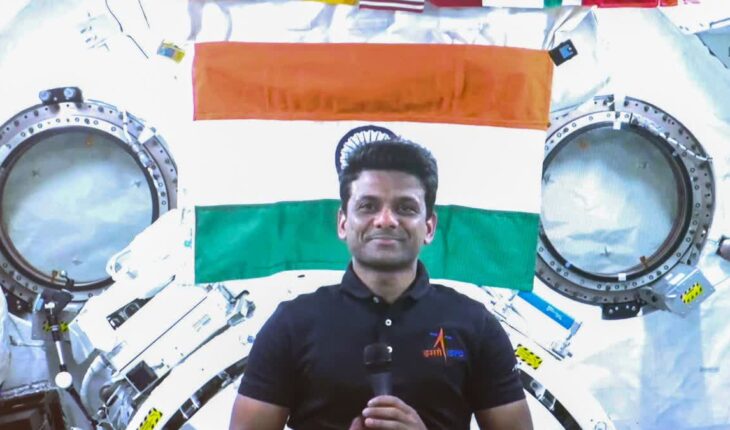
Group Captain Shubhanshu “Shux” Shukla, born in Lucknow on 10 October 1985, grew up in a middle-class household where the televised Kargil War first ignited his fascination with flight.
Legend in the family has him slipping away from his sister’s wedding festivities to sit the National Defence Academy entrance exam; he won a cadet seat and later graduated with a BSc in computer science.
Fighter-pilot wings followed in 2006, and Shukla soon logged front-line hours on Su-30 MKIs, MiG-29s, Jaguars and Hawks before qualifying as a test pilot at the Air Force’s Aircraft & Systems Testing Establishment.
An M.Tech. in aerospace engineering from the Indian Institute of Science rounded out a résumé that made him a natural choice when ISRO recruited its first gaganyatris in 2019.
Training took him from Russia’s Yuri Gagarin Cosmonaut Centre to ISRO’s Institute of Aerospace Medicine, but delays to the indigenous Gaganyaan launch pushed India to buy a berth on Axiom Space’s private Axiom-4 mission to the International Space Station.
Shukla was named pilot of the Crew Dragon Grace, which lifted off from Cape Canaveral on 25 June 2025 under the command of veteran astronaut Peggy Whitson.
After docking the next day, he became the first Indian ever to live aboard the ISS—and only the second Indian in space since Rakesh Sharma’s 1984 flight.
During 18 days on station Shukla oversaw seven Indian micro-gravity experiments, ranging from tardigrade survivability and muscle-loss “myogenesis” chips to trials of methi and moong sprouts and low-power avionics branded “Voyoger”.
He also helped run more than 60 multinational studies spanning 31 countries, reflecting Axiom’s commercial-science model. In a viral post-flight video he joked that “being still is a challenge” in micro-gravity, while International Moon Day found him photographing a waxing Moon through the Cupola, saluting Apollo 11 and India’s own lunar ambitions.
The Dragon splashed down off San Diego on 15 July 2025, returning more than 260 kg of research samples now bound for laboratories in India and the United States.
Shukla spent a week in readaptation protocols at NASA’s Johnson Space Center before flying to Bengaluru for public celebrations and ISRO debriefs.
Prime Minister Narendra Modi hailed the mission as “another milestone for Amrit Kaal”, the government’s vision of a confident, aspirational India.
Beyond national pride, the flight gives ISRO its first hands-on data set for crewed operations, feeding directly into Gaganyaan systems engineering; Shukla remains on the prime crew for that mission, now scheduled no earlier than 2026. His 20 days in orbit have also strengthened India–US space ties and signalled Delhi’s intent to be an active partner in the coming commercial low-Earth-orbit economy.
From the boy who slipped out of a wedding to sit an exam to the man who piloted a Dragon to the ISS, “Shux” Shukla embodies a generational shift: India is no longer a bystander in human space-flight, but a participant ready to translate fighter-cockpit discipline into orbital routine. As he told crewmates before undocking, “Today’s India is aspirational, fearless, confident and proud… Saare Jahan Se Accha still describes us best.”