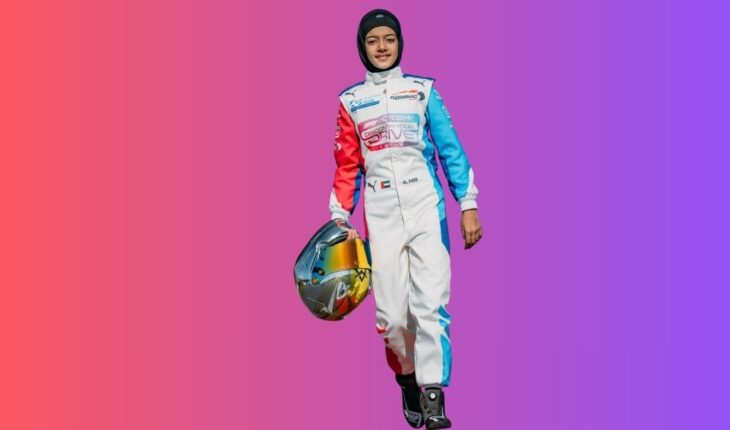
At an age when most children are still discovering hobbies, Atiqa Mir is already competing on some of the world’s most demanding karting circuits. The 11-year-old racer from Srinagar, Jammu and Kashmir, has emerged as one of India’s most promising motorsport talents and recently became the first Indian and Asian female driver selected for Formula 1 Academy’s “Discover Your Drive” programme, an initiative designed to identify and support young female talent in racing.
For Indian motorsport, her selection represents more than another junior-level achievement. Racing remains a niche and expensive sport in India, with limited infrastructure and relatively few opportunities for women. Atiqa’s rise therefore reflects not only exceptional talent but also the possibility of a more diverse future for Indian motorsport.
Born in Srinagar in 2014, Atiqa moved to Dubai with her family at a young age. The relocation proved crucial to her development. The UAE’s established karting ecosystem provided access to circuits, coaching and competitive opportunities that remain scarce in India. She began karting competitively at around six years of age and quickly developed a reputation for speed, discipline and racecraft.
Motorsport also runs in the family. Her father, Asif Nazir Mir, is a former racing driver and karting champion whose experience helped guide her early development. Yet family support alone cannot explain her success. International karting demands physical endurance, technical understanding, emotional control and the ability to compete against older and more experienced rivals. Atiqa has had to develop those qualities at an unusually young age.
Her progress has been marked by a series of notable milestones. In 2024, she became the first female driver to win a race at the Rotax Challenge International Trophy at France’s Le Mans Kart International circuit. Competing in the Micro Max category, she demonstrated the composure and consistency that distinguish promising youngsters from serious racing prospects. She also became the first Indian female driver to qualify for the Rotax Euro Trophy final, strengthening her growing reputation on the European karting circuit.
Those achievements have now led to an even bigger opportunity. Formula 1 Academy’s “Discover Your Drive” programme aims to expand the female talent pool in motorsport and create clearer pathways to higher levels of competition. Atiqa’s selection places her within a structured development environment linked to the highest levels of global racing. While it offers no guarantees in a sport as competitive as Formula 1, it provides valuable exposure, mentorship and recognition.
Her recent performances suggest that the confidence placed in her is well founded. In 2026, she delivered a dominant display in the Champions of the Future Academy programme in Greece, reportedly topping qualifying, winning both heats and then securing victory in the final. She became only the third driver in the series’ history to complete such a sweep in a single round. The sight of the Indian flag being raised after her victory helped bring her achievements to a wider audience beyond motorsport enthusiasts.
Atiqa has made no secret of her ambition to reach Formula 1. It is an enormous challenge. No woman has started a Formula 1 Grand Prix since 1992, and the journey from karting to the pinnacle of motorsport is notoriously difficult even for drivers with significant financial and institutional backing. Yet her results have ensured that her aspirations are taken seriously.
Her story also reflects the changing geography of motorsport. For decades, elite racing was dominated by Europe, where young drivers benefited from established racing structures and sponsorship networks. Atiqa represents a new generation of competitors who are using global development systems to overcome traditional barriers of geography and opportunity.
There remains a long road ahead. Success in karting must eventually translate into higher categories, and sustained progress will require funding, expert coaching, physical development and careful career management. The pressures facing young athletes can be considerable, and enthusiasm for her achievements should be matched by patience and support.
Yet what Atiqa Mir has already accomplished is remarkable. She has placed an Indian girl within one of motorsport’s most competitive development systems and demonstrated that talent can emerge from places the sport has often overlooked.
For Indian motorsport, Atiqa represents a glimpse of what the future might look like. For young girls watching from Kashmir, India and beyond, she offers something even more valuable: proof that the starting grid is open to them too.
Would you like to feature yourself or someone you know on Person Matters, a leading profile-based news portal? Write to us at info@personmatters.com