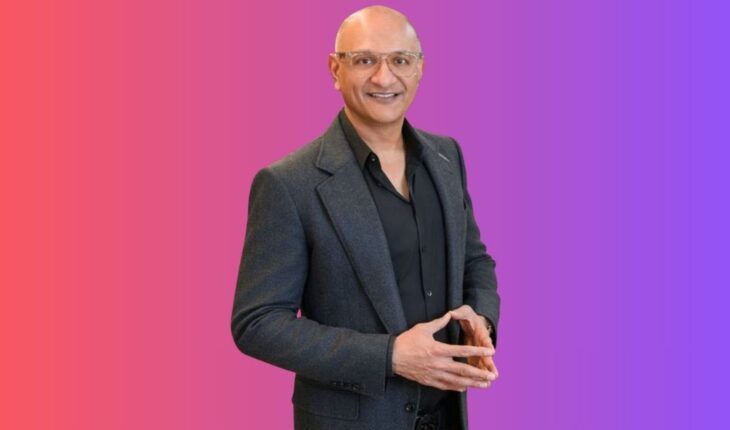
Jeetu Patel has emerged as one of Cisco’s most influential leaders and a prominent Indian-origin voice in the global technology and AI conversation.
As president and chief product officer at the networking giant, he sits at the centre of Cisco’s attempt to reinvent itself as an “AI-first” infrastructure and security company, overseeing product strategy across networking, security, collaboration and data/AI platforms.
His story follows a classic immigrant-entrepreneur arc. Born in India, Patel moved to the United States as a teenager and worked his way through school, including shifts as a waiter at a Sizzler restaurant, before entering the technology industry.
He went on to build a career that cut across consulting, enterprise software and cloud collaboration long before “product” became a fashionable job title in Silicon Valley.
Patel spent more than a decade at Doculabs, a boutique research and advisory firm he helped grow, before joining EMC’s Documentum division (later part of Dell EMC).
There he held senior roles in engineering, marketing and strategy, eventually becoming chief strategy officer and chief marketing officer for the Information Intelligence Group. That phase sharpened his reputation as an executive who could connect deep technical products with real-world enterprise needs.
In 2015 he moved to cloud-content company Box as chief product officer and chief strategy officer, where he was a key architect of the firm’s shift from simple file-sharing to a broader content-management and workflow platform, pushing deeper integrations with enterprise applications and public-cloud services.
He joined Cisco in 2020, at a delicate moment for the long-established networking firm. Webex, Cisco’s long-standing collaboration suite, was widely seen as lagging behind newer rivals such as Zoom and Microsoft Teams.
Tasked with reviving the franchise, Patel led a rapid product refresh that added noise-cancellation, real-time translation and AI-assisted meeting features, repositioning Webex as a serious competitor in enterprise collaboration.
Cisco’s leadership then handed him a much broader mandate. As executive vice-president and general manager for security and collaboration, and now as president and chief product officer, Patel has been charged with knitting together Cisco’s sprawling product portfolio into a coherent, AI-driven platform.
His remit spans everything from Webex and contact-centre software to the Cisco Security Cloud and the networking products that underpin corporate and telecoms infrastructure.
A central pillar of that strategy is Cisco Hypershield, an “AI-native” distributed security architecture designed to embed protection directly into networks, endpoints and clouds rather than relying on traditional perimeter firewalls.
Hypershield is being tightly coupled with data and observability capabilities from Cisco’s $28bn acquisition of Splunk, an integration Patel has presented as foundational for protecting AI workloads at hyperscale.
In interviews over the past two years he has argued that Cisco must behave like a 40-year-old start-up: moving faster, embracing AI at every layer and treating security as an integrated, data-rich platform rather than a patchwork of point products.
He has described the company’s current phase as an “AI reinvention”, claiming that the last 18 months of innovation outpace the previous decade and insisting that every new product now starts with an AI lens, whether it is code-generation tools for developers, AI contact-centre agents or autonomous “agentic” systems that execute tasks on users’ behalf.
Patel has also been outspoken on how AI will reshape software jobs. In recent conversations cited by Indian media, he has said that software engineers will increasingly be judged on two “grossly underestimated” skills: orchestrating complex workflows of intelligent agents and generating high-quality ideas, rather than simply writing code. Imagination, he has argued, will become the main constraint.
That view aligns with his broader push for clarity of purpose and focus, in which both founders and big-company leaders need to “choose ruthlessly” what they work on instead of chasing every new opportunity.
As one of the most senior Indian-origin leaders in global enterprise technology, Patel has become a vocal champion of India within Cisco.
On a recent visit to Mumbai with chief executive Chuck Robbins, he described India as “built into the fabric” of Cisco’s engineering organisation rather than a low-cost outpost. India-based teams, he noted, have rewritten core firewall stacks and lead major initiatives in cybersecurity and contact-centre software.
Cisco’s decision to bring its flagship Cisco Live conference to India for the first time was partly driven by Patel, who wanted global product leadership to treat the country as a key market and innovation hub in the AI era.
Coverage of his leadership style portrays Patel as a relentlessly hard-working but highly structured executive.
According to an interview highlighted by the Financial Express, his workdays can stretch to 18 hours, seven days a week, yet he imposes strict rules on his schedule: blocking off early mornings for thinking and problem-solving rather than meetings, and being deliberate about time with his family despite the demands of the job.
Colleagues say that philosophy runs through his framing of Cisco’s future: fewer, more integrated platforms rather than dozens of overlapping products.
With Cisco positioning itself as a “picks and shovels” provider for the AI boom — supplying networking, security and observability to hyperscalers and enterprises — Patel has become one of the company’s main public faces.
In forums ranging from Fortune India round-tables to specialist security podcasts, he has argued that the same AI capabilities that make cyber-attacks more dangerous can be used to build self-defending networks, provided companies invest in rich telemetry, unified platforms and human-in-the-loop oversight.
As generative AI, cybersecurity threats and geopolitical tensions collide, Patel’s role places him at the junction of some of the most consequential questions in enterprise technology: how to secure AI, how to modernise legacy infrastructure and how to turn a four-decade-old networking company into a platform for the next wave of computing.
For now, Cisco’s “AI-first” bet — and his stewardship of its product engine — will be watched closely by investors, customers and rivals alike.