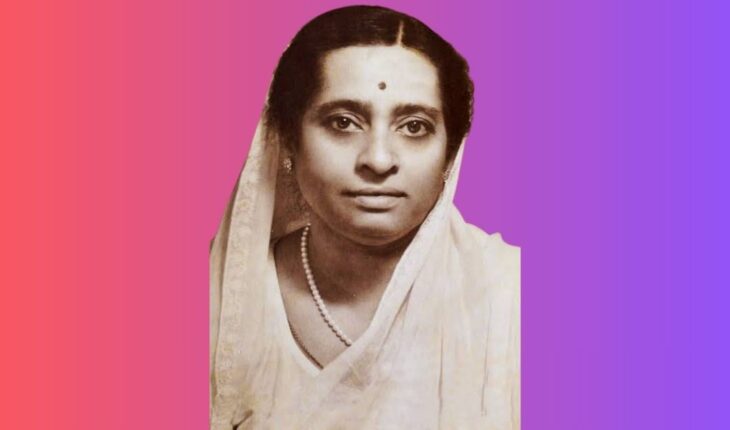
Long before India’s recent space missions captured the world’s attention, an Indian voice had already travelled beyond the reach of the planets. Kesarbai Kerkar, one of the finest Hindustani classical singers of the 20th century, was represented on NASA’s Voyager Golden Record, a collection of sounds and images sent into space in 1977. Nearly half a century later, her rendition of a raga is still travelling through interstellar space aboard Voyager 1.
Kerkar was born on July 13th 1892 in Keri, a village in present-day Goa. Her family later moved to Kolhapur, where she studied under several noted musicians. She eventually became the foremost disciple of Alladiya Khan, founder of the Jaipur-Atrauli gharana.
The training was exacting. Under Khan, Kerkar developed the command of complex ragas, precise intonation and powerful voice for which she became known. Rabindranath Tagore bestowed on her the title “Surashree”, or queen of melody. She came to be regarded as one of the leading exponents of khayal, the principal vocal form of Hindustani classical music.
Her career unfolded as radio and gramophone records were bringing classical music to a wider public. Yet Kerkar remained sparing in her performances and recordings. She sought control over how her music was presented and preferred a small body of accomplished recordings to a large but uneven one. The choice limited her recorded legacy, but also helped preserve her reputation for exacting standards.
One recording acquired a significance that neither she nor its original listeners could have foreseen. In 1977 NASA launched Voyager 1 and Voyager 2 to study the outer planets. Each carried a gold-plated copper record intended as a portrait of Earth for any intelligent beings that might one day find it.
Carl Sagan, an astronomer, led the committee that assembled the record. It contained greetings in 55 languages, sounds ranging from thunder to birdsong, and music drawn from several cultures. At the recommendation of Robert E. Brown, an ethnomusicologist, the committee included Kerkar’s performance of “Jaat Kahan Ho”, set in Raag Bhairavi. The recording, made in Bombay in 1953, was the record’s sole selection of Indian classical music.
Kerkar’s voice thus joined music by Bach, Beethoven and Mozart, as well as songs and instrumental works from Asia, Africa, Europe and the Americas. Its inclusion did more than give Indian music a place on the record. It presented a refined and demanding musical tradition as part of humanity’s account of itself.
Kerkar received several honours during her lifetime, including the Sangeet Natak Akademi Award and the Padma Bhushan in 1969. She died in September 1977, the same month in which the two Voyager spacecraft began their journeys. She could scarcely have known how far her recording would travel.
Voyager 1 crossed the heliopause in 2012, becoming the first spacecraft to enter interstellar space. It remains the most distant human-made object and continues to send scientific data to Earth, though its declining power has forced NASA to switch off instruments gradually. The Golden Record, requiring no power to survive as a physical object, will remain aboard it long after the spacecraft falls silent.
Kerkar’s place in musical history does not depend on that journey. She would still rank among India’s greatest classical singers had her voice never left Earth. But the Golden Record gave her art another role: it made one of her performances part of humanity’s message to the unknown.
India’s space programme is now marked by missions to the Moon, Mars and the Sun. Kerkar’s story points to a different kind of voyage. Before Indian spacecraft travelled far from Earth, an Indian musician’s voice had already been entrusted to the stars.
Would you like to feature yourself or someone you know on Person Matters, a leading profile-based news portal? Write to us at info@personmatters.com