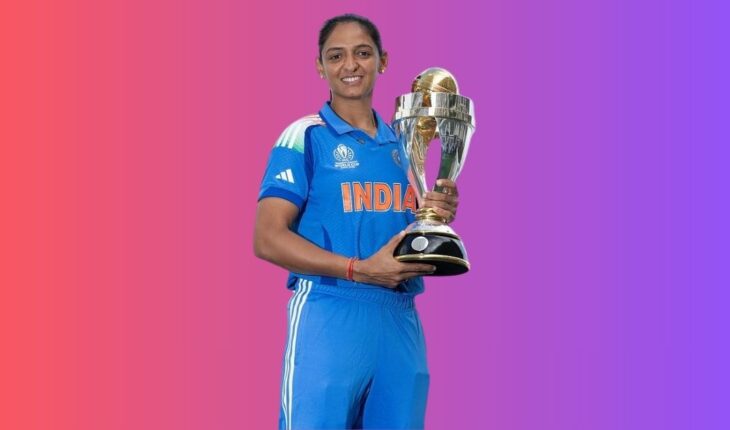
When Harmanpreet Kaur stepped down as captain of India’s women’s cricket team on October 6th 2026, she brought to a close one of the most significant chapters in the country’s cricketing history. The decision came less than a year after she led India to its first Women’s ODI World Cup title and barely two weeks after securing a second consecutive Asian Games gold medal. At 37, Kaur has relinquished the captaincy but remains committed to representing India as a player.
Her departure ends a leadership career spanning 211 international matches across formats. Under her captaincy, India developed from a formidable challenger into a World Cup-winning side. The responsibility now passes to Smriti Mandhana, her long-serving deputy, who inherits a team strengthened by experience, growing confidence and an ambition to compete consistently with the world’s best.
From Moga to the international stage
Born on March 8th 1989 in Moga, Punjab, Kaur grew up at a time when opportunities for girls in cricket were limited. Encouraged by her father, Harmandar Singh Bhullar, she pursued the game with determination. Training under Kamaldeesh Singh Sodhi helped develop the attacking batting style that would become her trademark. Long journeys to practise were part of her early struggle to establish herself in a sport still dominated by men.
Her international career began against Pakistan at the 2009 Women’s World Cup. A powerful right-handed batter and occasional off-spinner, she gradually earned recognition for her ability to attack bowling and change the course of a match. Her willingness to take risks distinguished her from many contemporaries and reflected a broader shift towards more assertive batting in women’s cricket.
The defining moment came in the 2017 Women’s World Cup semi-final against Australia at Derby. Facing the tournament favourites, Kaur struck an unbeaten 171 from 115 balls, including 20 fours and seven sixes. Her remarkable innings carried India into the final and remains among the most celebrated performances in the history of women’s cricket.
Although India lost the final to England at Lord’s, the innings had consequences far beyond the result. It drew attention to women’s cricket in India and demonstrated the match-winning ability of a generation increasingly unwilling to remain in the shadow of the men’s game.
A captaincy shaped by triumph and disappointment
Kaur’s first experience of international captaincy had come in 2012, when injuries to Mithali Raj and Jhulan Goswami placed her in charge for the Women’s T20 Asia Cup final against Pakistan. India won by 18 runs, offering an early indication of her leadership potential.
She became India’s regular T20 international captain in 2016 and assumed responsibility for the ODI and Test sides following Raj’s retirement in 2022. By then, she had established herself as one of the team’s most influential players, combining aggressive batting with an increasingly prominent leadership role.
Yet success proved elusive at major tournaments. India finished runners-up at the 2020 Women’s T20 World Cup and the 2022 Commonwealth Games. These disappointments raised questions about the team’s ability to withstand pressure in decisive matches. Kaur also faced scrutiny over inconsistent batting, emotional outbursts and disciplinary controversies.
Such setbacks complicated her reputation but did not define it. India won its first Asian Games cricket gold in 2023, while Kaur led Mumbai Indians to Women’s Premier League titles in 2023 and 2025. These victories reinforced her standing as a captain capable of leading successful teams in different competitive environments.
The World Cup that defined her legacy
The greatest achievement of her captaincy came in November 2025, when India won the Women’s ODI World Cup on home soil.
The semi-final against Australia provided a fitting demonstration of the team’s growing confidence. Chasing a daunting target of 339, India produced a remarkable victory. Kaur scored 89 and shared a decisive 167-run partnership with Jemimah Rodrigues, whose unbeaten 127 secured India’s place in the final.
India then defeated South Africa by 52 runs at Navi Mumbai to claim its maiden Women’s ODI World Cup title. The victory ended years of near misses and placed Kaur alongside Kapil Dev and Mahendra Singh Dhoni among Indian captains who had won the 50-over World Cup.
For Kaur, the triumph was more than a personal milestone. It rewarded years of perseverance and reflected the progress of a team that had repeatedly come close to winning major tournaments without securing the ultimate prize.
Her final assignment as captain brought another success. At the 2026 Asian Games in Japan, India retained the women’s cricket gold medal, defeating Sri Lanka by 147 runs. By then, Kaur had become the most-capped player in women’s international cricket and the first to captain a side in 150 women’s T20 internationals.
Leadership ends, influence remains
Announcing her departure, Kaur acknowledged the emotional weight of leaving a role that had shaped much of her international career. She expressed confidence in the team’s future and reaffirmed her commitment to contributing as a player. The BCCI praised her leadership, particularly her role in guiding India to its historic World Cup victory.
Her legacy, however, cannot be measured solely in matches, runs or trophies. Building on the foundations laid by pioneers such as Mithali Raj and Jhulan Goswami, Kaur helped establish a more confident and competitive identity for Indian women’s cricket. Her attacking approach encouraged younger players to embrace ambition, while her leadership coincided with a period of growing recognition for the women’s game.
The transition to Mandhana marks both continuity and change. The new captain inherits a successful team but also faces the challenge of sustaining that success across formats and major tournaments. Kaur’s experience could remain valuable, particularly in guiding younger players through the pressures of international competition.
From the cricket grounds of Moga to lifting the World Cup, Kaur’s career reflects both personal achievement and the wider progress of Indian women’s sport. Her captaincy has ended, but the standards she helped establish will continue to shape the team. For a player who spent much of her career challenging expectations, that may prove an enduring contribution.