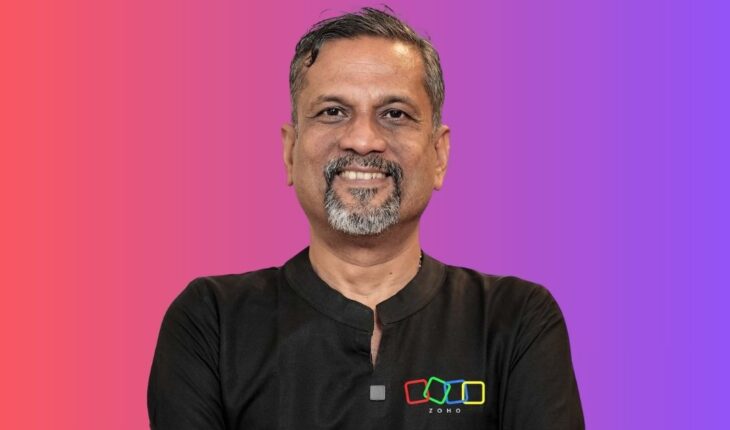
Sridhar Vembu is best known as the co-founder of Zoho Corporation and, until early 2025, its chief executive. In January 2025 he stepped down as CEO to become chief scientist, saying he would focus on deep research and development initiatives.
The move was widely read as a signal that Zoho intends to sharpen its emphasis on artificial intelligence and foundational technology, while keeping its founding team at the core of decision-making.
Vembu’s academic path is unusually heavyweight for a founder who later became an evangelist for building from small towns. He studied engineering at IIT Madras before completing graduate studies at Princeton University.
After his PhD he worked at Qualcomm, gaining experience in communications and systems engineering, before co-founding what would become Zoho.
The company began life in 1996 as AdventNet, a network-management software firm, long before “SaaS” became a buzzword.
Over time it pivoted into cloud business software and rebranded as Zoho Corporation in 2009, a shift the company itself marks as a turning point in its product strategy.
Zoho is now widely characterised as a bootstrapped B2B SaaS company, grown without venture capital and built to play the long game on product and culture.
In January 2025 the firm announced a major leadership reshuffle: co-founder Shailesh Kumar Davey took over as group CEO, while Vembu moved into the newly defined role of chief scientist.
The transition signalled continuity—co-founders still running core divisions—while freeing Vembu to concentrate on research-heavy bets at a time when enterprise software firms are racing to build defensible AI capabilities.
Alongside his role at Zoho, Vembu has become one of India’s most visible champions of a “rural-first” operating model, arguing that globally competitive software can be built while creating high-quality jobs in smaller towns.
Zoho has highlighted its long-running presence near Tenkasi in Tamil Nadu and the economic spillovers it claims from locating work there, under the banner of “rural revival”.
That theme has featured repeatedly in interviews and public appearances; in late 2025, when NDTV named him “Disruptor of the Year”, he spoke about tapping Indian talent “at the source” rather than funnelling everyone into metros.
His visibility extends into policy and public life. In 2021 the Government of India awarded him the Padma Shri, the country’s fourth-highest civilian honour, and appointed him to the National Security Advisory Board, underlining how his work is viewed not only through a business lens but also a strategic one.
Reports on Zoho’s internal culture often note his scepticism about hype cycles, his preference for frugal, engineering-led decision-making and even norms such as discouraging public flattery of leadership.
In 2025 he drew attention for sharing a cautionary anecdote about “agentic” AI—warning that without strong safeguards and human oversight, AI systems could leak sensitive information or act in unexpected ways.
Meanwhile, Vembu and his siblings have appeared in major rich lists on the back of Zoho’s privately held success, but his public persona remains that of a technologist and builder first, now formally re-centred in a role designed to keep him close to the science and engineering that will shape Zoho’s next phase.