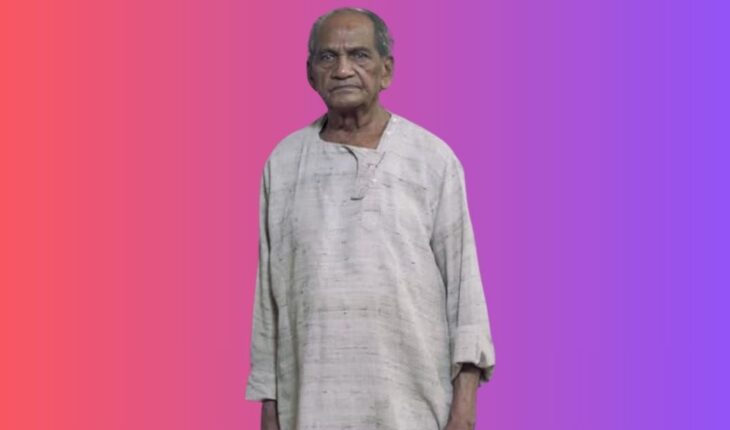
Veteran Indian sculptor Ram Vanji (Ram V.) Sutar, best known as the designer of Gujarat’s Statue of Unity – the world’s tallest statue – has died at his residence in Noida after age-related ailments, according to his family and reports carried by multiple outlets. He was 100.
His death closes a chapter in Indian public art that stretched from the early years of the Republic to the era of mega-monuments.
Born in 1925 in Gondur village in Maharashtra’s Dhule district, Sutar’s early life was steeped in craft.
He grew up in a carpenter’s family and began learning hands-on skills as a child, an apprenticeship-like upbringing that later fed into his signature realism in public sculpture.
He went on to train formally at Mumbai’s Sir J.J. School of Art, where he earned top recognition for modelling and sculpture.
That mix of artisanal grounding and academic rigour anchored a career that would span more than seven decades.
Sutar’s most globally recognised work is the Statue of Unity in Gujarat, the 182-metre tribute to Sardar Vallabhbhai Patel inaugurated in 2018.
The sheer scale of the project and its engineering-driven design process turned the statue into a symbol of India’s ambition to build cultural landmarks at a global level, and placed Sutar at the centre of one of the country’s most visible nation-building art projects of the 21st century.
Long before that commission, however, he was already a familiar name in India’s public-art circuit, shaping the visual language of state memorials, civic icons and national institutions – work at the intersection of art, politics and collective memory.
Much of Sutar’s output was devoted to Mahatma Gandhi. News reports and long profiles often highlight his many Gandhi statues installed across India and abroad, including prominent pieces associated with key public institutions.
In these accounts, his Gandhi sculptures are seen as part of the way independent India visually codified its moral and political ideals into enduring public forms.
Over the years he received major national honours, including the Padma Shri in 1999 and the Padma Bhushan in 2016, and was selected for the Government of India’s Tagore Award for Cultural Harmony the same year.
In his later years, Maharashtra moved to honour him with its highest civilian award, the Maharashtra Bhushan, underscoring how closely his work had become woven into modern India’s monumental landscape.
Sutar’s legacy is not defined by a single record-breaking statue so much as by the role he played in giving physical form to national identity.
His figures stand in public squares, on institutional campuses and in memorial spaces, quietly shaping how generations of citizens see their leaders and their history.
At a time when public art is increasingly drawn into political contest, his career is a reminder of how a sculptor can remain, above all, a builder of shared symbols – leaving behind work that, quite literally, endures in the way a nation sees itself.