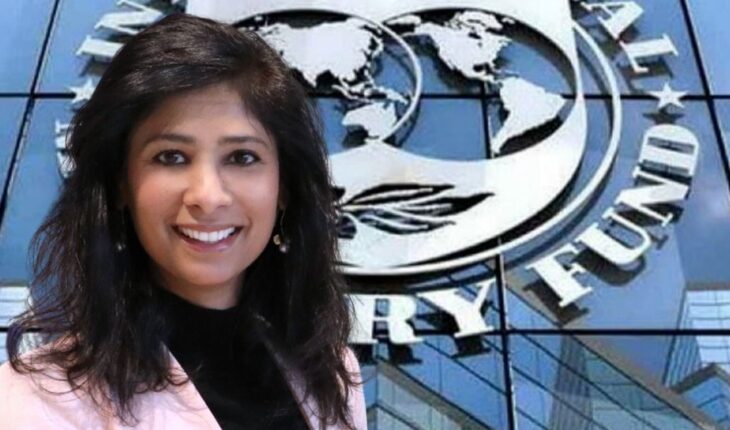
Gita Gopinath will leave the International Monetary Fund on 31 August 2025, closing a seven-year Washington stint that recast the Fund’s research culture and crisis playbook.
The Mysuru-raised economist, born in Kolkata on 8 December 1971, became the IMF’s first female chief economist in 2019 and, three years later, its first Indian-born first deputy managing director.
Now she is returning to the John Zwaanstra Professorship at Harvard to “advance the frontiers of research in international finance”, a move IMF managing director Kristalina Georgieva calls “a loss for the Fund but a gain for academia”.
Gopinath’s route from convent school to the top of multilateral policy was unusually direct.
After a BA at Lady Shri Ram College and an MA at Delhi School of Economics, she collected a second master’s at the University of Washington and a Princeton PhD supervised by Ben Bernanke and Ken Rogoff.
Four years on Chicago Booth’s faculty preceded a Harvard appointment in 2005; tenure followed in 2010, secured partly on path-breaking papers that showed how “dominant-currency pricing” distorts exchange-rate pass-through and capital-flow dynamics.
Central banks now hard-code her insights into forecasting models.
Recruited to the IMF in late 2018, she arrived just in time for Covid-19. Her “Pandemic Paper” set global vaccination and financing targets, launched the widely used COVID-19 Policy Tracker and coined “the Great Lockdown”, framing the Fund’s call for a record US $650 billion allocation of special drawing rights.
Promoted to first deputy managing director in January 2022, she oversaw the World Economic Outlook, G-20 dialogue and analytic work on inflation, digital money and climate risk while fronting tortuous negotiations on low-income-country debt. Georgieva credits her with “exceptional intellectual leadership amid wars and cost-of-living crises”.
Why step down now? Gopinath told the Financial Times she wants to study “the macroeconomics of a fragmenting world” and mentor the next cohort of scholars after two terms of near-continuous emergency management.
Her exit gives Washington—guardian of the FDMD slot—fresh scope to influence the Fund’s policy tilt just as the US presses for a narrower focus on balance-of-payments surveillance. Whoever succeeds her will inherit a research department whose output citing Gopinath’s own work has jumped from zero papers in 2019 to more than 50 today.
Honours have traced the arc of her career: a Pravasi Bharatiya Samman in 2019, election to the American Academy of Arts & Sciences in 2018, and listings in Bloomberg’s “50” and the Financial Times “25 Most Influential Women”.
Yet her enduring legacy may lie in the hybrid model she championed—an IMF that fuses frontier-grade scholarship with rapid operational response.
By returning to Harvard, she completes a rare loop from theory to policy and back, enriching both worlds and leaving the Fund better equipped for the next shock.