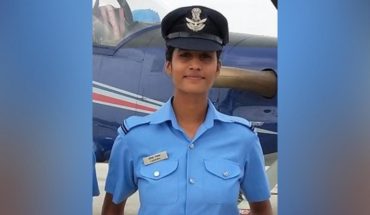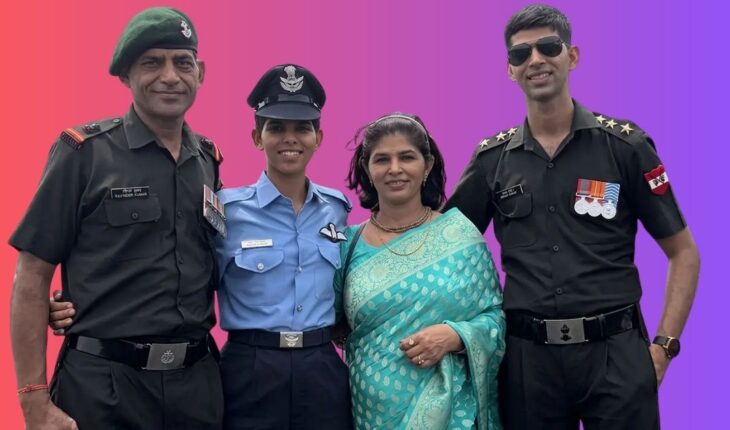
The commissioning of Flying Officer Minakshi Kumari marks another important chapter in the expanding role of women in India’s armed forces. A daughter of Haryana’s Charkhi Dadri and an alumna of Army Public School, Dhaula Kuan, she belongs to the first generation of women who entered the National Defence Academy (NDA) after the tri-service institution opened its doors to female cadets.
Her journey from a defence-family upbringing to the blue uniform of the Indian Air Force reflects both personal determination and a broader transformation within India’s military establishment.
Born in Charkhi Dadri, Haryana, Minakshi grew up in an environment shaped by military service. Her father, Subedar Major Ravinder Kumar, serves as a Junior Commissioned Officer in the Army, while her brother is also an Army officer. Like many children raised in defence families, she grew up surrounded by the routines, values and discipline associated with military life. In her case, those experiences appear to have helped shape an early ambition to serve in uniform.
That ambition was reinforced during her years at Army Public School, Dhaula Kuan, one of the country’s best-known defence-linked educational institutions. For Minakshi, the armed forces were not a distant aspiration but a familiar part of everyday life.
The decisive turning point came after the Supreme Court cleared the way for women to join the NDA. For decades, the academy had remained an exclusively male institution, even as women entered the armed forces through other commissioning routes. The admission of women cadets represented a significant shift in the training system that has long produced many of India’s military leaders.
Minakshi was among those who carried that change forward. On August 6, 2022, she joined the NDA as part of its first batch of women cadets. Like all NDA trainees, she faced a demanding schedule of physical conditioning, academics, military instruction and constant assessment. Yet the first women cadets carried an additional responsibility: they were helping define public perceptions of a historic experiment in military inclusion.
After completing her NDA training, she moved to the Air Force Academy at Dundigal near Hyderabad for specialised pre-commissioning instruction. There she entered the demanding world of aviation training, where precision, discipline and sound judgement are essential. The transition marked the final stage of her journey from cadet to officer.
In June 2026, Minakshi was commissioned into the Indian Air Force during the Combined Graduation Parade at the Air Force Academy. The occasion was historic because it included the first group of women NDA entrants to become IAF officers. The parade, reviewed by Defence Minister Rajnath Singh, saw 231 flight cadets commissioned, including 37 women officers and the first batch of ex-NDA women cadets.
Yet the significance of her commissioning extends beyond the milestone itself. India had already broken barriers in military aviation when Avani Chaturvedi, Bhawana Kanth and Mohana Singh became the country’s first women fighter pilots in 2016. Minakshi’s achievement belongs to the next phase of that evolution. She represents the NDA pathway, which trains officers from the earliest stage of military leadership development.
That distinction matters because the entry of women into the NDA changes the leadership pipeline itself. Young women can now begin their training alongside male cadets, compete within the same system and build careers on a similar institutional foundation. Minakshi’s commissioning therefore represents not only individual success but also a widening of opportunity within the armed forces.
Her story also reflects the enduring influence of military families. For her father and brother, both serving officers, seeing Minakshi wear the IAF uniform was undoubtedly a moment of pride. More broadly, it reflects a changing reality in which traditions of military service are being carried forward not only by sons but increasingly by daughters as well.
Flying Officer Minakshi Kumari’s career is only beginning. The true test of an officer comes in operational service, professional development and leadership responsibilities. Yet her place in India’s military story is already secure. She belongs to a generation of young women who transformed a legal breakthrough into a lived reality.
In that sense, Minakshi’s journey is about more than one officer. It reflects the evolution of an institution, the aspirations of a new generation and the gradual broadening of opportunities within India’s armed forces. For women entering military service today, the sky is no longer merely a symbol of possibility. It is a profession.
Would you like to feature yourself or someone you know on Person Matters, a leading profile-based news portal? Write to us at info@personmatters.com