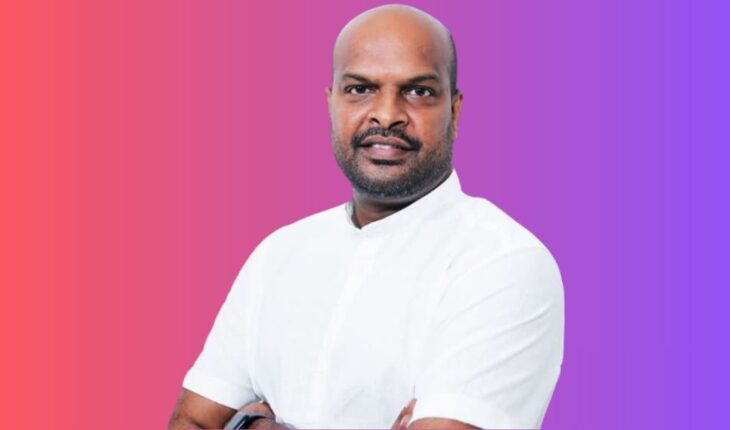
Vijay Arisetty’s public narrative is marked by a rare, sharply defined pivot: from Indian Air Force helicopter pilot to founder of one of India’s most recognisable gated-community platforms.
What connects the two chapters, as Arisetty has often explained in interviews, is not ambition but mindset — mission clarity, discipline under pressure, and the centrality of trust.
Those ideas shaped MyGate, the proptech company he co-founded, and have continued to define his public profile as the firm scaled rapidly, reset during the funding slowdown, and transitioned into a more mature phase of leadership.
Arisetty served in the Indian Air Force for about a decade as a helicopter pilot, a period he has described as foundational to his leadership philosophy.
Multiple profiles note that he was awarded the Shaurya Chakra for rescue operations during the 2004 tsunami in the Andaman and Nicobar Islands.
In later reflections, he has drawn direct parallels between aviation culture — process adherence, fast decision-making in uncertainty, accountability for outcomes — and startup leadership.
After leaving active service, he moved into finance, with stints at Bank of America and later Goldman Sachs, where he served as a vice president, before deciding to pursue entrepreneurship.
MyGate was founded in Bengaluru in 2016 by Arisetty along with Abhishek Kumar and Shreyans Daga.
The idea emerged from a simple but persistent urban problem: the fragile security layer at gated communities, where manual registers, inconsistent guard practices, and poor resident–security coordination created real vulnerabilities.
Arisetty has consistently framed MyGate’s mission as professionalising gatekeeping without devaluing security guards, emphasising dignity, training, and accountability as much as technology.
By the early 2020s, MyGate had become nearly synonymous with “society apps” in Indian cities. Business profiles reported the platform servicing around 25,000 gated communities, covering millions of homes, and processing enormous volumes of daily visitor entries.
Over time, the company repositioned itself from a pure security solution to a broader “community living” platform, layering home services, local commerce, and resident engagement tools on top of its original access-control backbone.
The company’s funding trajectory reflected broader shifts in India’s startup ecosystem. After early backing from Prime Venture Partners, MyGate raised $56 million in a Series B round in 2019 led by Tiger Global and Tencent.
In 2022, it raised ₹100 crore in a strategic round involving Urban Company and Acko, signalling a pivot toward partnerships, monetisation, and distribution synergies rather than headline growth alone.
Like many mid-stage startups, MyGate was forced to recalibrate during the funding downturn. In early 2023, the company laid off roughly 30% of its workforce, particularly in operations-heavy roles.
By FY24, however, reporting showed a sharp reduction in losses alongside revenue growth, driven by cost rationalisation. That stabilisation enabled an ESOP buyback for employees in 2024, offering partial liquidity and signalling financial discipline.
A major inflection came in April 2024, when Arisetty stepped back from day-to-day management.
Co-founder Abhishek Kumar was elevated to CEO, while Arisetty became chairman of the board, focusing on long-term strategy and leadership mentoring — a transition increasingly common as Indian startups move from founder-led execution to institutional governance.
Soon after, Arisetty re-entered the operating spotlight with Aurm, an asset-protection and safe-deposit locker venture, where he took on the role of founder and CEO in mid-2024.
Aurm’s pitch — addressing India’s shortage of secure storage through “military-grade” infrastructure — echoes themes from MyGate, extending the idea of security from community gates to personal assets.
As platforms like MyGate scale, debates around privacy and surveillance have intensified. Ground reporting has captured resident unease about data collection even as convenience and safety improve. That tension — between trust and data power — sits at the heart of Arisetty’s entrepreneurial identity.
Taken together, Vijay Arisetty’s journey illustrates how institutional credibility — earned in uniform and in finance — can be translated into consumer trust in urban infrastructure. MyGate’s arc shows the hard realities beyond early success: monetisation, layoffs, leadership succession, and public scrutiny.
His move to Aurm suggests a continued belief that “security as a service” will remain central to India’s urban future, even as the definitions of safety, privacy, and trust continue to evolve.