Navanethem “Navi” Pillay (born 1941, Durban) is a South African jurist and former UN High Commissioner for Human Rights (2008–14).
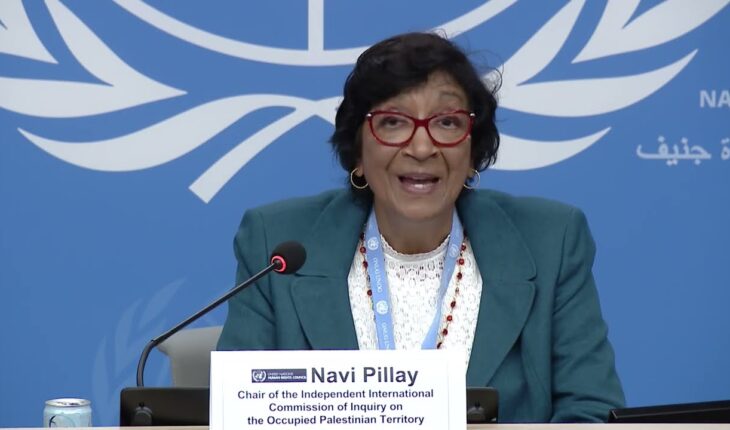
She now chairs the UN Independent International Commission of Inquiry on the Occupied Palestinian Territory, including East Jerusalem, and Israel.
A former judge on South Africa’s High Court, the UN’s Rwanda tribunal (where she served as president), and the International Criminal Court, she is currently a judge ad hoc at the International Court of Justice.
In a recent interview, she has stated that Israel is committing genocide in Gaza, drawing comparisons to the atrocities in Rwanda during the 1990s.
Early life and legal career
Raised under apartheid, Pillay became the first woman to open a law practice in Natal in 1967. In 1995 she was appointed the first non-white woman to South Africa’s High Court. She campaigned for the rights of political prisoners on Robben Island. She holds law degrees from the University of Natal and both a master’s and a doctorate from Harvard.
Judicial service and the UN
From 1995, Pillay served on the UN tribunal for Rwanda, where she helped establish legal precedent for treating sexual violence as a form of genocide.
She joined the International Criminal Court in 2003 and, in 2008, became the UN’s fifth High Commissioner for Human Rights, serving until 2014.
Fast facts
Born: 23 September 1941, Durban, South Africa
Education: University of Natal (BA, LLB); Harvard (LLM, JSD)
Firsts: First woman to open a law practice in Natal; first non-white woman on South Africa’s High Court
UN roles: Judge, ICTR (president); Judge, ICC; UN High Commissioner for Human Rights (2008–14); Chair, UN Palestine Commission of Inquiry (2021– ); Judge ad hoc, ICJ (current)
Chairing the UN Palestine Commission of Inquiry (2021– )
In July 2021, the president of the UN Human Rights Council appointed Pillay, along with Miloon Kothari and Chris Sidoti, to a standing commission of inquiry into violations in Israel and the occupied Palestinian territories.
The mandate includes examining root causes, such as discrimination and repression. Israel has refused to cooperate, and several Western governments have criticised the commission’s open-ended remit.
Findings of the commission
2022: The commission found that ending the occupation would not, on its own, halt systematic rights violations, which it linked to broader patterns of discrimination. Israel and the United States dismissed the findings as biased.
2024: Following the Hamas attacks of October 7th 2023 and Israel’s military response, the commission concluded that both parties had committed war crimes. Israel again rejected the findings as politicised.
2025: In its most consequential report to date, published in September 2025, the commission found reasonable grounds to believe that Israel is committing genocide in Gaza.
It cited four of the five acts defined in the 1948 Genocide Convention and referred to public statements by senior Israeli officials as evidence of intent.
The report highlighted mass killings, obstruction of aid, and the destruction of essential infrastructure. Israel called the report “scandalous” and politically driven.
Major outlets noted that, although the commission is independent, its finding amounts to the most severe legal conclusion yet issued within the UN system regarding Gaza.
Pushback and controversy
Pillay’s leadership has drawn sharp criticism. Israel and allied groups have accused her of bias, citing past remarks and activism. A 2022 campaign called for her recusal, which she rejected. That year, Kothari was widely condemned for referring to a “Jewish lobby” — a remark that provoked a wider debate on antisemitism and impartiality.
Governments have also raised objections to the commission’s structure and scope. The United States has called its work “one-sided”, and Israel has barred state officials from engaging with it.
Working style and public role
Pillay is known for judicial independence and a willingness to challenge powerful states. As High Commissioner, she pressed governments over abuses in Sri Lanka, Syria and elsewhere. More recently, she has led press briefings explaining the commission’s methodology, which includes witness testimony, satellite imagery and open-source analysis.
Current status
As of September 2025, Pillay remains chair of the commission. Its genocide finding has intensified scrutiny of Israel’s conduct and sharpened debate among states over responses, from arms transfers to sanctions. Political attacks on the commission have also grown louder.