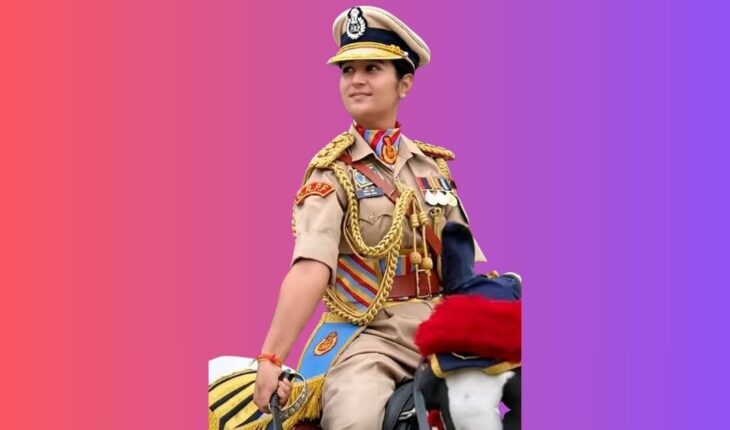
When the Central Reserve Police Force (CRPF) contingent marches down Kartavya Path on January 26, one officer at the front will be making history.
Assistant Commandant Simran Bala, 26, is set to become the first woman officer to lead an all-male CRPF marching contingent at India’s Republic Day parade — an honour that is ceremonial in form but exacting in its scrutiny within the force.
Bala hails from Nowshera in Rajouri district of Jammu and Kashmir, a border-region town where the presence of security forces is woven into everyday life.
Accounts of her journey consistently point to this geography as formative, shaping both her sense of discipline and her aspiration to serve.
Several reports also note that she is among the first, if not the first, woman officer from her district to join the CRPF, a distinction that has turned her into a point of reference for young aspirants in the region, particularly women.
Leading a Republic Day marching contingent is not a symbolic appointment handed out by announcement.
It is a competitive internal selection, determined through weeks of rehearsals, full-dress drills and repeated assessments.
Officers are evaluated on posture, command presence, voice control, precision of movement, squad alignment and composure under pressure.
According to reports, Bala was selected after a rigorous multi-stage evaluation process, standing out among contenders commanding a contingent of over 140 male personnel drawn from operational units.
Coverage of the selection process highlights her drill precision and authority during rehearsals, qualities that senior officers reportedly found decisive.
Bala herself has described the role as both an honour and a responsibility, emphasising the importance of cohesion, discipline and flawless execution in preparations for the parade.
Bala is a Group A officer recruited through the UPSC’s Central Armed Police Forces (CAPF) examination, a competitive pathway that supplies leadership across India’s central forces.
While reports vary slightly on the exact year and rank, multiple outlets agree that she cleared the examination on her first attempt with an all-India rank in the 80s before beginning her service with the CRPF.
Her profile is not limited to ceremonial excellence. Reports indicate that Bala has served in operational areas, including postings linked to Left Wing Extremism-affected regions in Chhattisgarh — experience that lends field credibility in a force where command authority is closely tied to operational grounding.
This balance between parade discipline and field exposure is often seen as essential for officers placed in high-visibility leadership roles.
The significance of Bala’s leadership extends beyond a single march. The CRPF, India’s largest central armed police force, treats its Republic Day contingent as a symbol of institutional discipline and professionalism.
A woman officer leading an all-male unit is therefore being widely read as a marker of evolving leadership norms in uniformed services, where opportunities for women have expanded but remain uneven across roles and appointments.
That symbolism has resonated strongly at home as well. Family reactions reported in the media describe her selection as a proud moment for Nowshera, reflecting how border districts often celebrate such milestones as collective achievements.
Bala’s story connects with audiences because it sits at the intersection of familiar national narratives: a border-town upbringing culminating on the country’s most visible ceremonial stage; advancement earned through drills, assessments and repetition rather than headline-driven exception; and the gradual reshaping of gender expectations in tradition-bound institutions.
On January 26, the moment itself will be brief — boots striking the boulevard, commands ringing out, a contingent moving as one. But behind it lie years of preparation, a selection process that rewards steadiness and authority, and a milestone that subtly widens the idea of who can lead whom in India’s uniformed services.