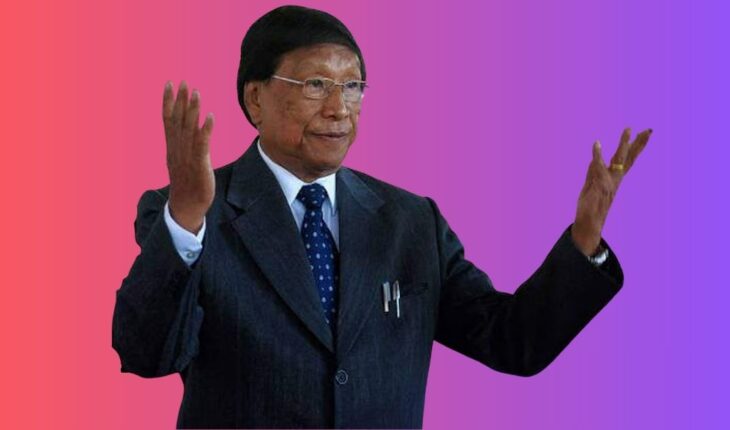
Thuingaleng Muivah, born on March 3, 1934, is a towering figure in the Naga nationalist movement. As the General Secretary and de facto chief of the National Socialist Council of Nagaland (Isak-Muivah), or NSCN (I-M), Muivah has remained the movement’s most enduring strategist and political voice.
His recent return to his ancestral village in Somdal, Ukhrul district, Manipur — after over five decades — has reignited public interest in the Naga question, drawing massive crowds and symbolic tributes from civil society across Naga-inhabited regions.
Muivah’s political journey traces back to the Naga National Council (NNC), where he rose through the ranks during the 1960s.
He vehemently opposed the Shillong Accord of 1975, deeming it a betrayal of Naga aspirations, and co-founded the NSCN in 1980 alongside Isak Chishi Swu and S.S. Khaplang. Following a violent split in 1988, Muivah and Swu led the Isak-Muivah faction — now the dominant Naga insurgent group — with Muivah as general secretary and Swu as chairman until the latter’s death in 2016.
The NSCN (I-M) entered a ceasefire with the Government of India in 1997, opening a protracted period of dialogue. The 2015 Framework Agreement marked a milestone, acknowledging the Nagas’ “unique history and position,” though crucial issues like a separate flag and constitution remained unresolved.
Muivah has consistently asserted that these elements are non-negotiable, viewing them as symbols of Naga identity and sovereignty. He also frequently references the Amsterdam Joint Communiqué of 2002, further underlining his interpretation of the Naga mandate.
His 2025 homecoming was laden with symbolism. For many, it was a moment of cultural affirmation. Traditional Naga troupes, schoolchildren waving Naga flags, and coordinated civil society mobilisations reflected the deep emotional and political resonance of his return.
The United Naga Council even declared a district-wide holiday in Senapati, underscoring his stature in the region. The significance of this visit was heightened by historical context — earlier attempts to visit, notably in 2010, had been blocked by the Manipur government, sparking violent protests.
In public addresses during his visit, Muivah restated the NSCN (I-M)’s core positions: that the Naga flag and constitution must be recognised explicitly in any final settlement, and that the Framework Agreement remains “sacred and binding.” His rhetoric also included pointed criticism of New Delhi, accusing it of reneging on previously understood terms.
These statements come at a sensitive moment, with peace talks in a fragile phase and the central government reluctant to accommodate demands that fall outside India’s constitutional bounds.
Muivah’s presence also reactivates ethnic sensitivities in Manipur, where long-standing tensions between hill and valley communities have been further strained by violence since 2023. While his return was celebrated in Naga-majority areas, it triggered unease in the Imphal valley, echoing memories of earlier unrest.
Despite his advancing age, Muivah remains the ideological fulcrum of the NSCN (I-M), even as a younger leadership has assumed formal roles — such as chairman Qhehezu Tuccu.
The group maintains a significant presence in Nagaland and Manipur, with cross-border networks extending into Myanmar, keeping alive the goal of a pan-Naga homeland — another sensitive topic in peace negotiations.
As he reiterated in a recent interview, the movement will persist unless India “accepts Naga identity.” His message was clear: diluted compromises will not suffice. For Naga civil society, his statements and return reaffirm the centrality of identity and historical continuity.
For the Indian state, his re-emergence is a reminder that enduring peace hinges not only on security arrangements but also on constitutional imagination and political empathy.
Muivah’s life and leadership span insurgency, diplomacy, negotiation, and now legacy. His Ukhrul visit may not shift the government’s red lines, but it has certainly redrawn the emotional and political contours of the Naga struggle.
Whether viewed as a leader of resilience or of unyielding maximalism, Muivah’s presence ensures that the Naga question remains a live challenge for Indian federalism — one that demands resolution, not deferral.