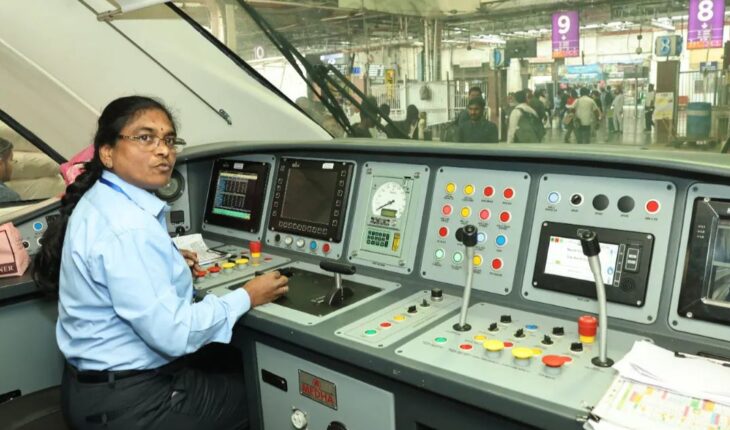
In 1988–89 a young recruit from Satara, Maharashtra, became Asia’s first woman to drive a train for Indian Railways. Over a 36-year career, Surekha Shankar Yadav (née Bhosale) moved from goods trains to Mumbai’s suburban services, mastered the demanding Western Ghats section, piloted iconic expresses such as the Deccan Queen, and in 2023 became the first woman to operate a Vande Bharat Express. She retired on 30 September 2025, feted by Central Railway and widely hailed as a pioneer.
Early life and entry into the cab
Born in Satara to a farming family, Yadav studied locally and joined Central Railway after training at Kalyan. She cleared recruitment interviews in the late 1980s, worked as a trainee assistant and then, in 1989, as an assistant driver—breaking into what was then an all-male job category. She has often credited her parents’ support for a career that demanded irregular hours and long commutes.
Climbing the ranks
Yadav began on shunters and goods trains, then qualified as a Ghat driver for the steep, curving Western Ghats—among the network’s toughest assignments—before moving to passenger and suburban services in Mumbai. The progression underlined the breadth of traction and terrain she learned to handle.
Milestones
- Deccan Queen (2011): On International Women’s Day she drove the storied Mumbai–Pune intercity, a symbolic breakthrough for Indian Railways’ gender milestones.
- Vande Bharat (2023): She became the first woman loco pilot to operate India’s semi-high-speed Vande Bharat Express on the Solapur–CSMT route, a feat highlighted nationally.
- All-women crew (2025): On International Women’s Day 2025, Central Railway fielded an all-women crew on a Vande Bharat from CSMT, reflecting the widening scope of women’s roles across operations.
Recognition and influence
Across interviews, Yadav has framed the job as one of presence of mind and teamwork rather than brute force. Her visibility helped draw more women into running categories—from suburban EMUs to intercity rosters—while normalising safety protocols for late hours and expanding instructor roles that improved retention. As she approached retirement in 2025, tributes from railway colleagues, industry leaders and the wider public saluted a “trailblazing” service record.
The final stretch: retirement in 2025
Central Railway announced Yadav’s retirement for 30 September 2025 after 36 years of service. Farewell events at CSMT brought together colleagues and family members. In closing media interactions she distilled her lesson simply: you need heart to face life’s challenges.
Why her story endures
Yadav’s arc mirrors three shifts in Indian Railways:
- Breaking entry barriers (late 1980s): women moving into running crews;
- Expanding responsibilities (2000s–2010s): from suburban to intercity and ghat sections;
- Symbolic leadership (2020s): as a face of modernisation—Vande Bharat—and of all-women operating teams.
Few careers knit these eras together so visibly. Yadav’s journey is not only a first in the record books; it is a map of how institutions change when one person opens the door and leaves it wider than she found it.