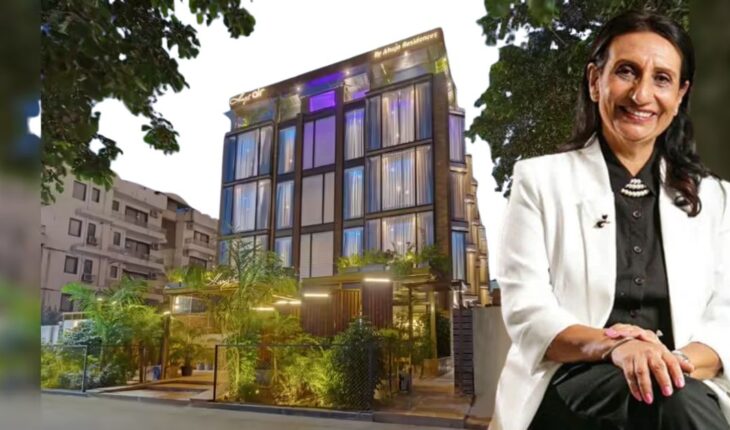
Rashmi Ahuja’s entry into hospitality is tied to a defining moment in Delhi’s modern history: the 1982 Asian Games. As the capital prepared to receive a surge of international visitors, she sensed an opening.
What began as a small bed-and-breakfast during that period would, over time, grow into Ahuja Residency — now also branded as Ahuja Residences — a family-run portfolio spanning boutique hotels, serviced apartments and managed housing.
Profiles of Ahuja describe a founder who did not begin in business. A graduate of Delhi University, she taught at a leading school for three years before deciding to build something of her own. That choice was unusual for a young woman in the early 1980s.
Married at 19 and a mother soon after, she nonetheless pressed for independence, insisting on professional recognition in her own name. The decision to start a venture was as much personal as commercial.
The enterprise itself began modestly. She persuaded her father-in-law to let her use the first floor of the family home in South Delhi and secured a loan of ₹5,000 to prepare the space for guests. Demand during the Asian Games helped her repay early dues within months.
From the outset, the model rested on discipline rather than display: a limited inventory, close supervision and an emphasis on attentive service. The company’s own account of its origins frames 1982 as the year of founding, built on what it calls “thoughtful hospitality”.
The next step came not from a boardroom plan but from observation. Early expatriate guests often needed help settling into Delhi — finding homes, understanding neighbourhoods, arranging domestic support.
Ahuja moved into that gap. In doing so, she positioned herself in what would later be known as the serviced-apartments segment, long before the category acquired formal definition. The shift from short stays to longer corporate housing broadened both revenue and reputation.
Over time, “Residency” evolved from a single property into a platform. Today Ahuja is described as founder and chairperson, while operational leadership has passed to the next generation. Her son, Jaideep Ahuja, serves as managing director and chief executive.
The brand’s public language centres on a “home-away-from-home” promise, aimed at corporate travellers, expatriates and relocating families.
Rather than hinge its identity on one landmark address, the group has built a network of repeatable, reliable properties in business and cultural districts.
Its portfolio spans boutique hotels, serviced suites and managed housing, including niche offerings such as Japan-focused stays.
Recent expansion underlines that steady approach. In late 2025 the group added three properties in Gurugram — HAYs AIR at Mayfield Garden, AR Suites at JMD Sohna Road, and Ahuja Residency GCR near Golf Course Road — covering boutique luxury, serviced suites and business-hotel formats.
The announcement, attributed to Jaideep Ahuja, signals generational continuity but also reflects the operating template Rashmi Ahuja established: flexibility across stay formats, calibrated to different business needs.
What distinguishes Ahuja’s trajectory in India’s crowded hotel landscape is less flamboyance than endurance. Many founders are defined by marquee properties or aggressive scale.
Her story, by contrast, is one of gradual expansion along logical adjacencies: from a homegrown B&B to corporate stays, from serviced apartments to multi-city boutique hotels.
Reporting on the group consistently highlights operations and guest experience as the core differentiators.
The brand’s appeal lies in predictability — rooms that function well, locations that suit working travellers, and service that rewards repeat custom.
More than four decades after the Asian Games, the founding instinct remains visible. Ahuja saw a moment of demand and built cautiously into it. The portfolio that now carries her name suggests that in hospitality, as in other service industries, longevity may rest less on spectacle than on steady, attentive growth.