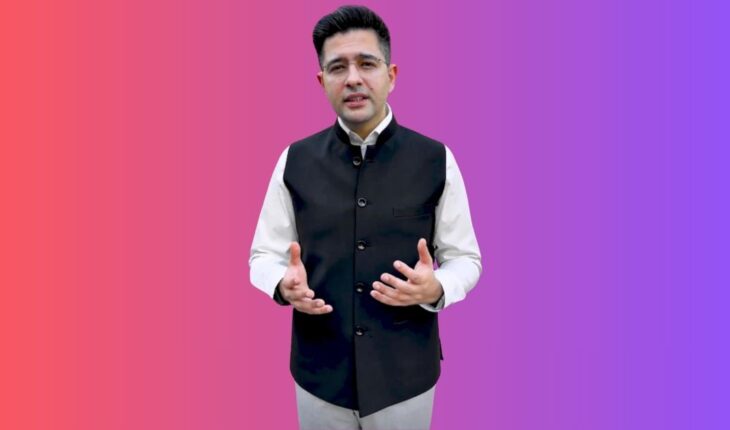
For much of his political career, Raghav Chadha embodied the youthful, articulate face of the Aam Aadmi Party: a leader who rose quickly through its ranks, won the confidence of Arvind Kejriwal and became one of the party’s most recognisable national voices.
Today, however, Chadha appears to be entering a more complicated phase, marked by reduced prominence and growing questions about his place in the party’s changing power structure.
A swift rise in a young party
Born in Delhi in 1988, Chadha entered politics through the anti-corruption movement that gave birth to the AAP. A chartered accountant by training, with experience at global firms and exposure to institutions such as the London School of Economics, he quickly established himself as a strategist and spokesperson.
Within a few years, he had become one of the party’s youngest national leaders. He served as its treasurer, emerged as a familiar face on television and later won election as an MLA from Delhi’s Rajinder Nagar. His ascent was rapid and, by many accounts, unusually smooth in a party otherwise shaped by grassroots struggle.
By 2022 he had entered Parliament as a Rajya Sabha member from Punjab, becoming one of the youngest figures in the Upper House.
The trusted lieutenant
Within AAP’s inner circle, Chadha was widely seen as one of Kejriwal’s most trusted aides, often described as his “blue-eyed boy”.
His influence was especially visible in Punjab, where he was seen as playing an important part in the party’s successful 2022 Assembly campaign. He came to be viewed as Delhi’s eyes and ears in the state and as part of the core decision-making group.
At the national level, he was also involved in alliance-building and parliamentary coordination, reinforcing the sense that he belonged to AAP’s next generation of leadership.
This period defined Chadha’s political image: polished, articulate, media-savvy and firmly embedded in the party’s power structure.
Turbulence and strain
That trajectory, though, has not been free of disruption.
In 2023 Chadha was suspended from the Rajya Sabha following allegations linked to a parliamentary committee nomination dispute, with accusations of procedural violations levelled against him.
In 2024 he faced further political heat after allegations, which he strongly contested, linked him to controversial figures in Punjab policing.
At around the same time, pressure within AAP intensified as investigations and arrests involving senior leaders altered the party’s internal balance. In that more unsettled atmosphere, Chadha’s own prolonged absence during crucial political moments, reportedly because of medical treatment abroad, also attracted attention and criticism among both political observers and supporters.
A visible setback
More recent developments suggest a clear shift in Chadha’s standing within the party.
He was removed as AAP’s deputy leader in the Rajya Sabha and replaced by another MP, a move widely read as a sign of declining influence. Reports have suggested that his once central role, especially in Punjab and in parliamentary strategy, has diminished, with some observers describing it as a political fade-out.
The change has come alongside signs of internal friction. Some voices within the party have publicly questioned his positioning and commitment, hinting at tensions deeper than a routine reshuffle.
Chadha, for his part, has responded with caution, saying that he has been “silenced, not defeated”, a line that suggests he still believes there is political ground left to recover.
A politician in transition
Yet it would be premature to write him off. Chadha remains a sitting MP and continues to raise issues in Parliament, ranging from governance reforms such as the “right to recall” to more everyday matters such as toll policies.
His core strengths remain much the same: ease in front of cameras, fluency in policy language and a measure of urban political appeal. What has changed is the context around him.
AAP itself is going through a period of recalibration, shaped by electoral setbacks, legal pressure and changes within its leadership. In such a party, closeness to power is no longer assured, even for those who once seemed to enjoy it most.
The larger lesson
Chadha’s story reflects a broader truth about Indian politics: a rapid rise can be followed by an equally rapid reassessment.
In a party built on anti-establishment ideals, but now forced to navigate the pressures of office and institution, internal hierarchies are bound to shift. Leaders once seen as symbols of the future may find that they must continually renegotiate their space.
For Chadha, then, the question is no longer one of ascent but of relevance.
Can he redefine his role within the AAP? Can he emerge as a more independent political voice? Or will he remain a diminished figure in a party he helped to build? Those answers are still unfolding.
But one thing is already clear: Raghav Chadha’s story is no longer simply about promise. It is about survival on the shifting ground of power.