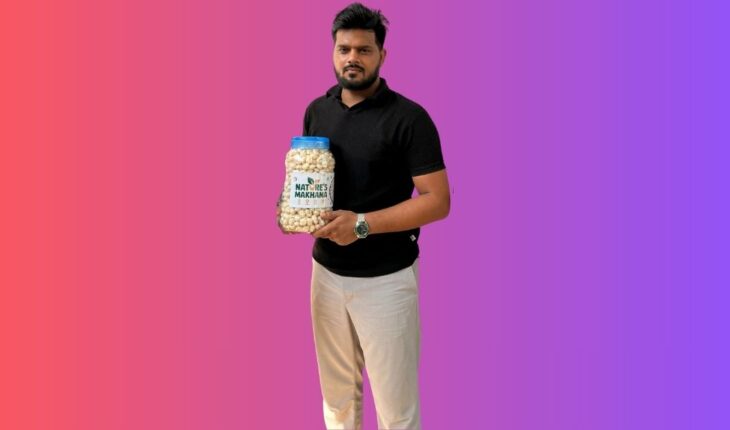
Nadeem Iqubal, a young entrepreneur from Katihar, Bihar, is the founder of Nature’s Makhana, a B2B superfood venture that supplies graded raw makhana (fox nuts) to food businesses across India.
Launched in 2024, the startup builds on a three-decade-old family trade in makhana, led by his father, Md. Raish.
Drawing on this legacy, Iqubal has formalized and scaled what was once a largely unorganized sector riddled with middlemen and pricing inefficiencies.
His story has recently gained media traction, especially for pushing makhana — traditionally sold in bulk “tauli” sacks — into a more structured, quality-graded supply business.
By introducing consistent size and whiteness grading, Iqubal offers minimum order quantities (MOQs) of 150 kg to B2B buyers, positioning Nature’s Makhana as a reliable procurement partner.
This transformation was seeded with a ₹1 crore loan from the family business and included setting up a storage and sales hub in Khari Baoli, Old Delhi, while keeping procurement rooted in Bihar.
The venture’s growth has been significantly fueled by a low-cost digital strategy. Short Instagram Reels — simple clips overlaid with text and visuals from warehouses and production units — have become a high-conversion lead-gen tool.
Iqubal reports that a single ₹500 boosted reel once brought in ₹3 lakh in orders.
According to Startup Pedia, monthly revenue grew from around ₹1 crore in late 2024 to ₹3 crore by mid-2025, largely from these inbound leads.
Nature’s Makhana currently operates as a raw-ingredient B2B brand, supplying manufacturers and private-label buyers.
With pricing benchmarks such as ₹1,35,000 for a 150-kg lot, Iqubal claims a per-order profit margin of ₹20,000–₹25,000, depending on season and grade.
The real differentiation lies in standardization: even 10 grams must fill a pack, he says — underscoring the precision buyers expect in institutional supply chains.
Bihar dominates India’s makhana production, with the crop enjoying a GI tag as Mithila Makhana.
The government’s proposed Makhana Board could further catalyze the sector, especially for players like Nature’s Makhana that align farm-gate sourcing with quality-conscious national demand.
While many brands have gone D2C with flavored makhana snacks, Iqubal has stayed B2B — focusing on consistency, supply reliability, and channel marketing where his buyers already are.
Key claims around revenue and operations are sourced from a detailed Startup Pedia profile, based on interviews with Iqubal.
While these figures are currently unaudited, the company’s digital footprint — particularly its @naturesmakhana Instagram — corroborates its positioning and marketing strategy.
Looking ahead, Nature’s Makhana’s success will hinge on disciplined working capital management, scale-ready sourcing, and whether it chooses to expand into D2C or export private-label SKUs.
For now, its focused B2B strategy — and its founder’s clarity on channel and quality — keeps it firmly rooted, and growing, in India’s evolving superfood economy.
(With inputs and photo from Startup Pedia)