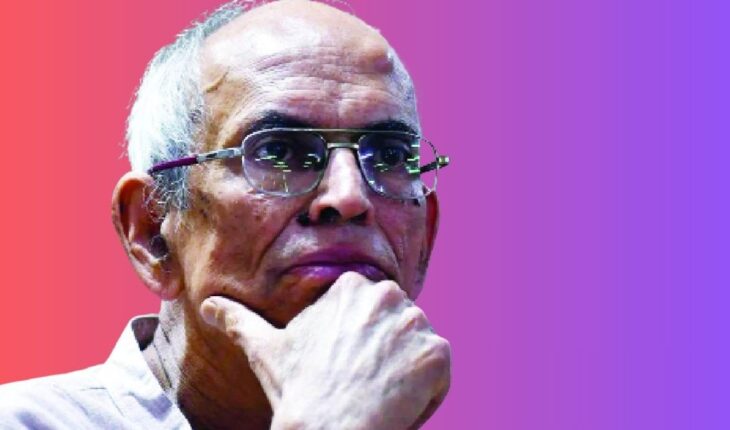
Madhav Gadgil (1942–2026) was one of India’s most influential ecologists — a scientist who combined academic rigour with grassroots engagement, and who repeatedly challenged governments and the public to confront the ecological costs of unchecked “development.”
He died in Pune on 7 January 2026, prompting a wave of tributes that described him as a “people’s scientist” and a defining voice in India’s environmental policy discourse.
Gadgil’s intellectual formation bridged elite academic training and deep field experience. After early education in Maharashtra, he completed his doctorate at Harvard University, before returning to India to help establish ecology as a research discipline.
He was closely associated with the Indian Institute of Science (IISc), where he played a key role in building institutional capacity for ecological research.
Throughout his career, Gadgil advocated for a people-centred approach to conservation. He argued that ecological protection could not succeed without the involvement of local communities — particularly in biodiversity-rich landscapes where people live, cultivate land, and depend on natural resources.
He helped mainstream the use of People’s Biodiversity Registers (PBRs), a tool that formalised community knowledge of local flora and fauna, reflecting his conviction that knowledge must flow both from science to society and from lived experience to policy.
This orientation shaped how he engaged with environmental conflicts. Gadgil did not restrict his interventions to academic papers or committees; he frequently travelled to affected regions, engaged with local groups, and spoke out against projects he believed exceeded ecological thresholds. His method was both scientific and participatory.
He is widely recognised as a key architect of India’s biodiversity governance framework. His contributions supported a national shift towards participatory, decentralised natural resource management.
His influence extended beyond laws and committees to how India understood biodiversity itself — not as an abstract national asset, but as something tied to local stewardship and ecological limits.
Gadgil is best known to the public as chair of the Western Ghats Ecology Expert Panel (WGEEP), set up by the Ministry of Environment and Forests.
The panel’s 2011 report, based on scientific data, geospatial mapping, and stakeholder consultations, proposed a graded model for protecting ecologically sensitive zones. Though backed by many environmentalists, the report provoked sharp resistance from political and industrial interests in affected states.
A subsequent government-appointed panel diluted several of its recommendations — especially those related to community participation and environmental safeguards — a move Gadgil publicly criticised.
Nowhere was this conflict more visible than in Kerala, where Gadgil’s warnings about fragile hillscapes and disaster risks became central to public debate.
His concerns about road construction, quarrying, and slope modification were echoed by local groups, particularly after repeated landslides in regions such as Wayanad.
For many, his voice embodied a difficult truth: that so-called “natural disasters” were increasingly the result of policy failure and ecological neglect.
In recognition of his lifelong work, the United Nations Environment Programme named Gadgil a Champion of the Earth (Lifetime Achievement) in 2024, citing his commitment to conservation rooted in science and community knowledge.
His legacy lies not only in institutions, reports, or honours, but in a method: begin with ecological reality; treat people as part of the ecosystem, not as obstacles; insist on science-based, transparent decision-making; and accept political discomfort as the cost of honest environmental governance.
His death, and the renewed debate around the Western Ghats, are reminders that India’s ecological choices are now economic, social, and moral questions — and that Gadgil spent a lifetime warning that their consequences were avoidable.