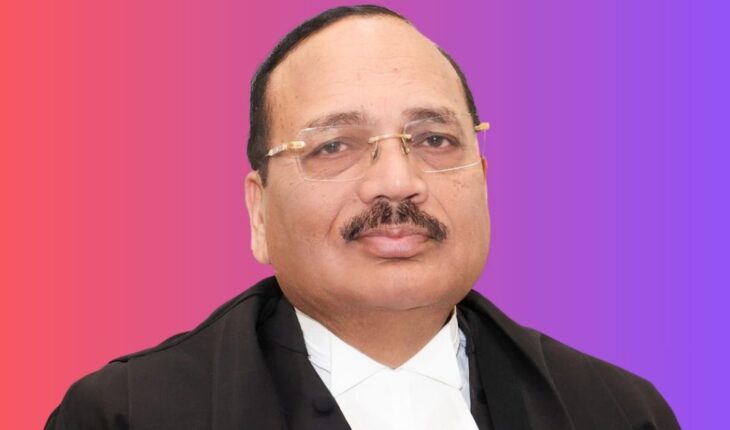
Justice Surya Kant has been appointed as the 53rd Chief Justice of India. He is due to take the oath on 24 November 2025, following the retirement of the current CJI, Justice B.R. Gavai, a day earlier.
His term, which will run until 9 February 2027, stands out for its length — among the longer recent tenures.
At a time when India’s highest court has seen a rapid succession of short-term CJIs, a 15-month window offers the possibility of greater continuity and institutional reform.
His elevation follows the well-established convention of seniority. Earlier this week, Justice Gavai formally recommended him as successor.
The government swiftly accepted the nomination, completing a smooth and orderly transition in the apex court’s leadership.
This practice of internal endorsement, rather than political appointment, has long underpinned the judiciary’s independence in India.
Justice Kant’s rise reflects a traditional but steady judicial career. He began as Advocate General of Haryana and was designated a Senior Advocate in 2001.
In 2004, he joined the bench of the Punjab and Haryana High Court. Fourteen years later, he was appointed Chief Justice of the Himachal Pradesh High Court.
On 24 May 2019, he was elevated to the Supreme Court, where he has served since. His judicial service will culminate in February 2027 when he reaches the mandatory retirement age of 65.
Over the course of his career, Justice Kant has contributed to some of the Supreme Court’s more consequential rulings. He is known for judgments that uphold the idea of public commons and procedural fairness.
In Jitendra Singh v. Ministry of Environment, he affirmed that village ponds are protected public utilities under Article 21 of the Constitution. The judgment held that even replacing such water bodies does not justify their destruction, as doing so infringes upon the right to life.
In the field of criminal justice, his opinion in CBI v. Sakru Mahagu Binjewar clarified that life imprisonment does not equate to a fixed 20-year term.
The ruling upheld a sentence of 25 years without remission, emphasising proportionality in sentencing and rejecting the misinterpretation of Section 57 of the Indian Penal Code.
Justice Kant has also participated in high-stakes constitutional matters. These include hearings on Article 370, the One Rank One Pension scheme, the structure of tribunals, the minority status of Aligarh Muslim University, and cases related to Pegasus surveillance, the Agnipath military recruitment scheme, and appointments to the Election Commission.
Some of these matters have been resolved; others remain pending, scattered across multiple benches or phases of argument.
His jurisprudence tends to focus on social rights and systemic reform. He has been noted for his writing on gender justice, education, and prison conditions.
As a High Court judge, he directed authorities to allow conjugal and family visits within reformatory prisons — an unusual move that sought to humanise incarceration.
His judgments reflect a concern for dignity and due process, and a belief that judicial remedies must extend to those on the margins.
Justice Kant will assume office at a time when the Supreme Court faces an unwieldy caseload and a pressing need to reorganise its docket.
With a relatively long tenure ahead of him, he is expected to drive reforms in case listing, digitisation, and the scheduling of Constitution Benches.
The court must still hear long-pending references on federalism, the powers of governors, the role of tribunals, and electoral law.
He will also have the opportunity to shape the Court’s internal functioning. With several recent CJIs serving only brief stints, the promise of steadier leadership could allow him to consolidate benches, streamline administration, and promote coherence in the Court’s work.
Observers see his term as a chance to bring some order to a fragmented and overburdened institution.
Justice Kant’s elevation follows a well-trodden path through the judicial hierarchy — state law office, High Court judge, Chief Justice of a High Court, Supreme Court judge, and now CJI.
Yet the breadth of his experience, and the relatively generous span of his tenure, give his appointment added significance.
He will have more time than most recent CJIs to influence not just the judgments the Court delivers, but the manner in which it functions.
Born in 1962 and educated at Maharshi Dayanand University in Rohtak, Justice Kant brings both legal acumen and administrative experience to the office.
His leadership will be tested not only by the Court’s crowded constitutional calendar, but by how he addresses systemic reform — from case management to transparency and judicial infrastructure.
Justice Surya Kant will take charge of India’s highest court on 24 November 2025.
In a court that too often lurches from one brief tenure to the next, he has the time, and perhaps the mandate, to set its tone and tempo afresh.