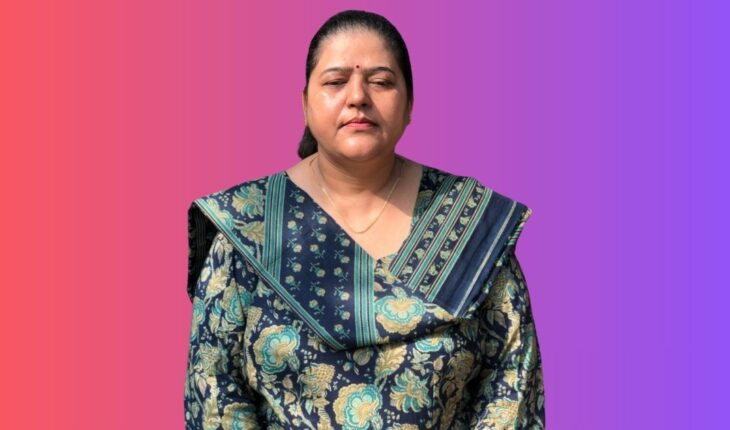
Dr Kiran Kumari, an assistant professor in the Department of Sociology and Social Anthropology at Punjabi University, Patiala, is emerging as one of Punjab’s most respected voices in disability rights and inclusion.
Visually impaired herself, she combines academic rigour with lived experience to influence both research and policy.
Her work came into national focus between August and October 2025, when she secured a prestigious research grant from the Indian Council of Social Science Research (ICSSR) and was profiled in national media for her long-standing efforts to improve disability infrastructure on campus.
Kiran joined Punjabi University in 2011, having lost her sight reportedly due to meningitis.
Over the years, she has quietly become a catalyst for change, not only through teaching and research but also through practical interventions that make the campus more inclusive.
In 2021, the university formally launched a Centre for Disability Studies — an initiative she had championed for years.
Appointed as its coordinator, she shifted from informal advocacy to institution-building, helping shape programmes around accessible pedagogy, student mentoring, and inclusive learning environments.
Media coverage in 2025 brought renewed attention to her work, especially The Indian Express profile that highlighted her persistence in securing basic accessibility upgrades on campus — such as ramps, signage, and reading spaces for visually impaired students — despite limited institutional support.
Alongside these efforts, her ICSSR-funded research project underscored the national relevance of her scholarship and lent weight to her calls for better integration of disability considerations into higher education policy.
Dr Kumari’s academic output sits at the intersection of disability, gender, and social structures.
Notable among her publications are a study on the Impact of Social Support and Psycho-Social Problems of Visually Impaired (published in IJRSS), and The Intersection of Disability and Gender-Based Violence, based on fieldwork with visually impaired women in Punjab.
These works move beyond theory, pairing empirical research with recommendations for systemic change. Her current ICSSR project builds on this trajectory, aiming to produce findings that can shape university practices and inform broader state-level programming.
Her contributions have been recognised at both national and state levels. She was conferred the President’s National Award for Role Model in 2018, an honour that acknowledged her ability to supervise postgraduate research and teach effectively despite visual impairment.
In 2025, she was also named a Punjab state icon for persons with disabilities, coinciding with International Women’s Day outreach.
Her public service includes assisting the district administration during the 2019 elections, where she trained officials in accessible voting protocols.
Much of her impact, however, lies in the classroom and the campus culture she has helped reshape.
Known for mentoring visually impaired students, she has mainstreamed Braille use, adapted assessments, and inclusion-oriented pedagogical methods.
Earlier media profiles described her as a role model who transformed barriers into opportunities for learning and leadership.
The creation of the Centre for Disability Studies in 2021 was a turning point. Though modest in resources, it provided a formal platform for advocacy and research that Kiran had already been pursuing for years.
Disability networks noted that she had proposed such a centre two years earlier, envisioning it as a way to modernise academic delivery and support structures.
Even as university headlines in 2025 focused on broader institutional matters, her “quiet battle” for practical improvements continued to resonate — as an illustration of the slow but essential work of turning policy promises into visible outcomes.
Her ICSSR project now positions her and her team on the national research map, giving them a stronger voice in shaping guidelines issued by the University Grants Commission and other bodies.
As coordinator of a fledgling centre, she is well placed to translate findings — on gendered violence, social support, and learning barriers — into tangible policy at the university level.
At a time when many Indian state universities still lack any formal disability studies programme, her efforts offer a replicable model for embedding inclusion into the institutional fabric of higher education.
In an academic landscape where disabled scholars are still underrepresented, Dr Kiran Kumari stands out — not only for her personal perseverance, but for building a bridge between lived reality and structural change.
Her work, both scholarly and practical, is a reminder that inclusion is not just a policy idea; it is daily effort, often led by those who know its absence best.