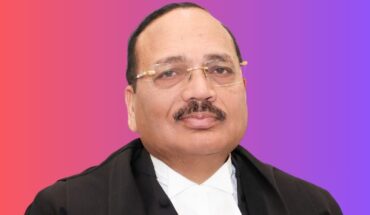
Bhushan Ramkrishna (B.R.) Gavai, born on 24 November 1960 in Amravati, Maharashtra, is the 52nd Chief Justice of India (CJI).
A judge of the Bombay High Court from 2003, he was elevated to the Supreme Court in 2019 and took oath as CJI on 14 May 2025, with a tenure running until 23 November 2025.
His appointment marked two notable firsts for the court: he is India’s first Buddhist CJI and only the second judge from the Scheduled Castes to hold the office, after K.G. Balakrishnan.
Gavai’s term at the top of the judiciary is often described as a bridge between his predecessor and his successor.
He followed Justice Sanjiv Khanna, who served a brief six-month term from November 2024 to May 2025, and is in turn set to pass the baton to the next senior judge,
Justice Surya Kant, under the established seniority convention. Court and press commentary alike have framed his tenure as a link in this chain, providing continuity while the leadership of the Supreme Court transitions in quick succession.
Substantively, Gavai’s judicial record is defined by his presence on several of the Supreme Court’s most consequential recent benches.
In 2024 he was part of the five-judge Constitution Bench that unanimously struck down the Union government’s electoral-bonds scheme for anonymous political donations, holding that it violated voters’ right to information.
The previous year he sat on the five-judge Bench that upheld the abrogation of Article 370 and Jammu & Kashmir’s special status; as CJI he later linked that ruling to B.R. Ambedkar’s vision of “one Constitution” for the country, a remark that underlined his broadly integrationist reading of the basic structure.
Beyond these marquee cases, Gavai has figured in a series of politically sensitive matters as a Supreme Court judge. He was on the Bench that stayed Rahul Gandhi’s 2023 criminal defamation conviction, a decision with clear electoral implications.
Law reports also place him on benches dealing with challenges to demonetisation, the use of “bulldozer justice” in state actions against properties, and other high-salience disputes at the intersection of law and politics.
According to the court’s own profile, in six years at the apex court he has sat on roughly 700 benches and authored around 300 judgments spanning constitutional, criminal, commercial and environmental law.
Commentators often describe his stance as a blend of institutional conservatism, evident in the Article 370 ruling, and a strong tilt towards transparency in cases such as electoral bonds — positioning him near the court’s pragmatic centre.
As CJI, even in a short tenure, he has taken decisions with lasting institutional impact. In May 2025 he presided over the swearing-in of three new Supreme Court judges — Atul Chandurkar, N.V. Anjaria and Vijay Bishnoi—restoring the court to its sanctioned full strength of 34 judges.
That numerical completeness matters for case management, bench constitution and the court’s ability to tackle its vast backlog.
His elevation has also carried clear symbolic weight. As the first Buddhist CJI and only the second Dalit to head the judiciary, Gavai’s appointment has been widely read as a milestone for representation at the summit of India’s constitutional structure.
Coverage of his oath ceremony stressed this diversity dimension, while his later travel to Jammu & Kashmir, against the backdrop of the Article 370 judgment, drew attention for the political and emotional resonance it held in the Valley.
Looking beyond November 2025, when he retires on turning 65, the focus shifts to how the institution will build on the themes that emerged during his time in office.
With Justice Surya Kant expected to succeed him under the seniority norm, the court will face tests on at least two fronts: whether it sustains the transparency thrust of the electoral-bonds verdict in matters of political finance and disclosure, and how it handles continuing federal-sensitive questions around citizenship, reservations and the overhaul of criminal law.
Gavai’s brief but visible tenure thus leaves a double legacy: a symbolic marker on questions of representation, and a doctrinal marker on the balance between constitutional integration and openness in political funding.